Restoration of Leda and the Swan
Below: Reconstruction of Leda and Swan currently under construction Copyright © 2012 leonardoresearch.jp


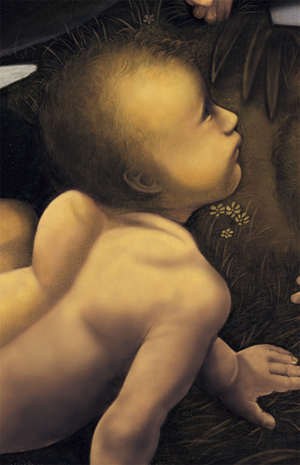

Lost sketch
Leda and the Swan is a masterpiece created by Leonardo in the early 1500s.
If the completed work had survived today, it would undoubtedly be one of Leonardo's masterpieces.
Unfortunately, the work was never completed by Leonardo, and the full-size carton of the sketch remains lost.
At the time Leonardo painted this sketch of Leda and the Swan, he was at the peak of his career as a painter, and at the same time he was creating the Mona Lisa. Considering the period in which it was produced, it is easy to imagine how outstanding Leda and the Swan was.
If possible, I would like to see the full-size carton that Leonardo drew, but it is difficult to do anything about it, so I would like to at least feel a glimpse of Leda and the Swan that Leonardo was trying to draw. I started creating a reconstruction of the statue about 10 years ago.
I used the following four works as reference when creating this work.
1. Raphael's drawing
2. Leda and the Swan in the Borghese Gallery
3. Leda and the Swan in the Uffizi Gallery
4. Leda and the Swan at Wilton House Trust
The overall composition and background depiction of the restored drawing adopts the composition of Leda and the Swan in the Uffizi Gallery.
The reason is that if Leonardo were to paint Leda and the swan, I would imagine that he would have Leda's wind-blown hair standing out against the dark background. Furthermore, the depiction of the rocks in the background is extremely similar to the background depiction of Our Lady of the Rocks, giving a strong sense of Leonardo's atmosphere.
On the other hand, regarding Leda's proportions, the reconstruction drawings reflect Raphael's drawings and the proportions of Leda and the Swan in the Borghese Gallery.
I feel that these two works were relatively early in production. The reason is that the poses of the infants depicted at Leda's feet are different. In the later stages, Leonardo perfected this infant pose and incorporated it into his paintings, so this free infant pose is a feature that can only be seen in the early stages.
Furthermore, there are some differences in Leda's proportions between the earlier and later periods. In the early versions of Raphael and Borghese, Leda's proportions give the impression of being somewhat slender and elongated, whereas in the later versions (Leda and the Swan in the Uffizi Gallery, Leda and the Swan in Wilton House), the proportions of Leda are slightly more voluptuous and elongated. I have the impression that it is lacking.
It is up to the individual to decide whether to use the earlier or later version, but in my case, I choose the earlier version because I believe in Raphael's drawing ability.
In addition, Leda and the Swan at Wilton House has the most detailed depiction of the swan, two sets of infant twins, and flowers, so the depiction of the area around Leda is based on this painting.
In this way, I created a reconstruction of Leda and the Swan by extracting Leonardo-like characteristics from multiple derivative paintings and combining them into a single painting.
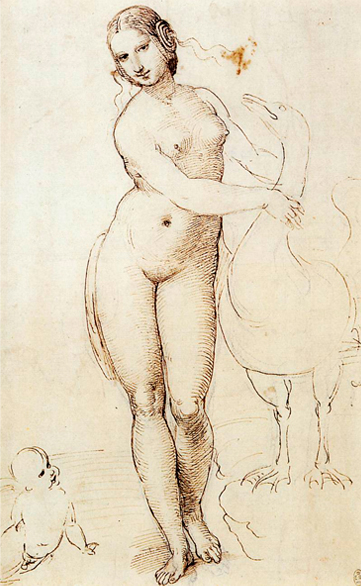 Left: Raphael sketched the Mona Lisa and this painting in Florence in 1504.
It is thought to be the earliest copy of Leonardo's full-size carton, and it differs from later derivative paintings of Leda and the Swan.
A particularly big difference is the direction of Leda's line of sight; in this drawing, Leda is looking straight at you.
It may be extremely unlikely that Leda was actually depicted in Leonardo's full-size carton with her eyes turned toward the viewer in this way.
However, there are some aspects that cannot be completely denied.
It is a study of Leonardo's overall composition for Leda and the Swan, with two of the three paintings showing traces of the gaze directed straight ahead, and the other directed toward the swan.
In this way, in the early stages of creating Leda and the Swan, Leda's gaze is not necessarily limited to the infant.
Another thing I'm paying attention to in this picture is the rough way Leda's arms and swan are drawn.
Regarding this point, I think that rather than Raphael's omission, Leonardo left the depiction of this part unclear at this point.
In the end, this part was left unfinished, and it is believed that this is the reason why various versions of this part were created in later derivative paintings of Leda and the Swan.
Comparison with derivative paintings
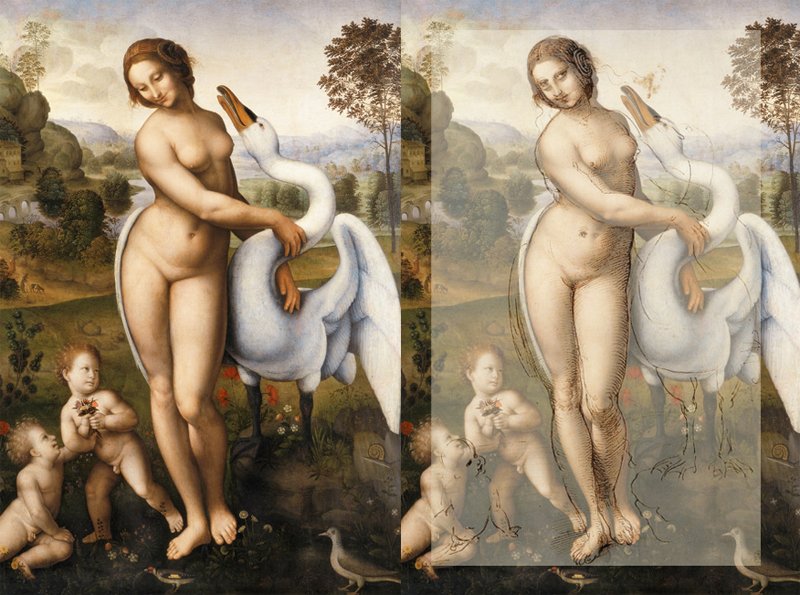
In the image below, the left side is Leda and the Swan from the Borghese Gallery, and the right side is an image with Raphael's drawing superimposed on it.
Although the proportions (ratio from head to toe) are almost the same, there are some areas where the outline of the body is off. For example, in Borghese's Leda, the line of the right foot is shifted inward compared to Raphael's drawing. As a result, you can see that the right leg is much thinner than the left leg. I have the impression that perhaps a line a little closer to Raphael would have been correct in this part.
In addition, the outline from the right shoulder to the waist is drawn on the outside of Raphael.
Although this part is a slight difference, it is an important part of the painting, and even a slight deviation in this part can greatly change the impression of the painting. Therefore, when drawing the restoration map, I was very worried about how to draw this part, and it took a lot of trial and error.
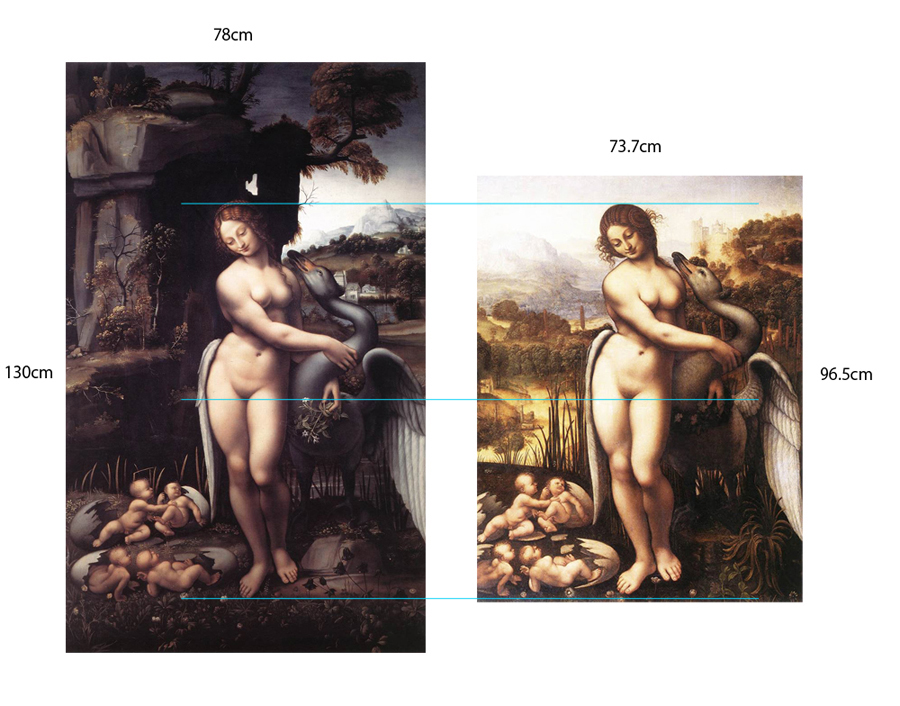
Comparison of later versions
What I consider to be later versions of Leda and the Swan are the Uffizi Gallery's Leda and the Swan and the Wilton House Trust's Leda and the Swan.
The image below is a comparison of the two works. The images are scaled and arranged so that the vertical size of Leda and the Swan from the Uffizi Gallery on the left is 130 cm, and the vertical size of Leda and the Swan from Wilton House Trust on the right is 96.5 cm. You can see that Leda is the same exact size in these two works.
Furthermore, the image below is an image of Leda and the Swan from Wilton House Trust superimposed on the image of Leda and the Swan from the Uffizi Gallery.
The images match almost perfectly, so it's hard to tell whether the images are superimposed or not. Based on this, it is highly likely that these two works were created from the same transfer sketch.
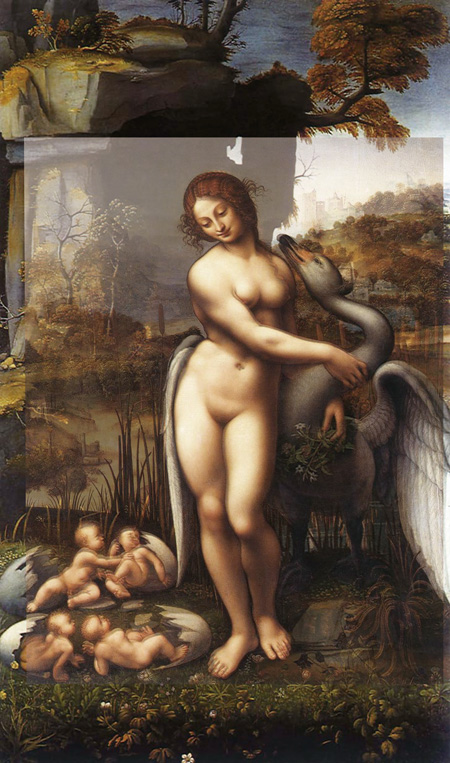 Left image: An image that combines the two images above
You can see that in addition to Leda, the swan and the twin infants are almost identical. It would be almost impossible for a human being to match two paintings to this degree with just visual inspection.
It is thought that Sporbello was probably used to transfer the image.
The fact that Sporbello is used in this way means that there was a sketch for transfer, and a likely theory is that this sketch was the full-size carton drawn by Leonardo.
However, I am negative about this theory.
The reason is that it is difficult to feel a Leonardo-like atmosphere from these two paintings.
There are two parts that make it difficult to feel that atmosphere. One is Leda's proportions (the position of Leda's crotch), which is lower than the previous version, so her torso is slightly longer and her legs are shorter. As a result, the overall proportions are a little strange.
The other thing is Leda's contrapposto, and I'm concerned about how the way her body twists is depicted in a simple way.
Leonardo tends to dislike simple and flat depictions, and conversely tends to prefer poses that are complex and difficult to depict.
My honest impression is that the pose drawn by Leonardo is somewhat flat and difficult to accept.
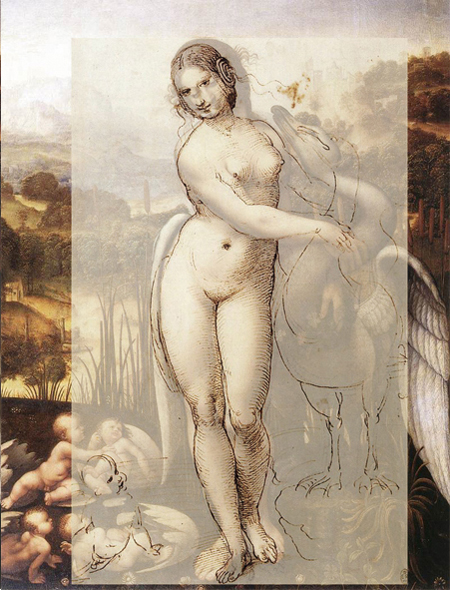 Comparison of early and late periods
The image on the left is a superimposition of Raphael's drawings on Leda and the Swan from Wilton House Trust.
The two major differences are the position of the right shoulder and the height of the crotch.
In Raphael's drawing, Leda not only twists her body to the right, but also tilts it downwards. As a result, the depiction of Leda's twisting body becomes more three-dimensional and has an increased sense of dynamism.
Another difference is the height at which the crotch is drawn; you can see that the Wilton House Trust's Leda and the Swan are drawn slightly lower.
This slight difference makes a big difference in proportion, giving the painting a completely different impression.
Production timeline of Leda and the Swan
I have summarized the production timeline of Leda and the Swan as follows.
1. Accepted the production of Leda and the Swan (around 1501-1502)
2. Creating a sketch of the rough composition
3. Production of a full-size carton (full body drawing of Leda, part of the infant, and rough figure of the swan)
4. Interruption or cancellation of production of Leda and the Swan (around 1503)
5. Raphael's drawing (1504)
6. A request was made to another painter to continue the production of Leda and the Swan, or an artist who witnessed the drawing offered to continue the production (Second Milan period)
7. Assisting other artists in continuing their work, providing sketches for unfinished parts (drawings of two sets of infants, drawings of head hairstyles, drawings of swans, etc.)
8. Completion of Leda and the Swan by another artist
I think the big mystery surrounding Leonardo's Leda and the Swan is why Leonardo stopped production.
I believe that the reason Leda and the Swan was discontinued was because the person who commissioned this painting was Cesare Borgia. Cesare was Leonardo's de facto patron at the time.
By this time, Cesare was rapidly gaining power and was even approaching the suburbs of Florence. On August 18, 1502, Cesare hired Leonardo as an architect and military engineer. I believe that during this period, Leonardo, as a painter, was ordered by Cesare to create paintings of naked women.
It is possible that the production of Leda and the Swan was a task that Leonardo was reluctant to undertake, as he had to respond to the demands of his new patron.
Then the turning point suddenly came. Cesare's downfall in 1503.
In August 1503, Cesare's father, Alexander VI, who had supported him, died, and in November, Cesare himself was taken prisoner by order of Julius II, who was his father's political enemy. Leonardo returned to Florence in March 1503, about six months before Cesare's downfall.
It is thought that the production of Leda and the Swan was probably discarded around this time (around 1503).
The main reason why Leda and the Swan, which was in the middle of production, did not become a completed work may be that the client of the work fell out of favor, but another reason is that it was a title that Leonardo did not want to draw in the first place. One of the reasons may be that I didn't feel like completing it because it wasn't.
Paradoxically speaking, I conclude that the person who commissioned the production of Leda and the Swan was the person with the power who semi-forced Leonardo to paint a work he did not feel like completing with his own hands. You can also do that.
I believe that Cesare Borgia is the most suitable person to make such demands on Leonardo at this time.
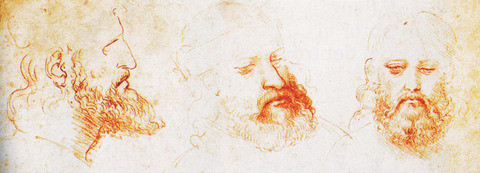
The image above is a portrait of Cesare Borgia painted by Leonardo.
Leonardo was left-handed, so he had the habit of always drawing from right to left. In this picture, the front face on the far right is drawn first. You can see that this first sketch of the front is much more delicate and detailed than the other angles. Then, as you draw from the center to the left edge, the depiction becomes rougher.
Looking at the picture, it seems like it was drawn quite quickly from the middle. Cesare Borgia may not have been able to sit still in front of Leonardo for long.
I feel like I can feel the relationship between the two even from this small sketch.
http://leonardoresearch.jp/ September 20 2015

leonardoresearch.jp