Lost masterpiece: Battle of Anghiari
Leonardo's drawing for the Battle of Anghiari
I have three themes. The first is the Last Supper, the second is Leda and the Swan, and the third is the Battle of Anghiari.
I am currently in the process of drawing this third theme, the Battle of Anghiari, but I feel that it will take a considerable amount of time to complete. In the case of the Battle of Anghiari, there is an overwhelming lack of basic materials regarding the composition and depiction of details.
In the first place, when Leonardo discarded this painting, he had only painted the central part of the battle scene, and the left and right parts had only a rough composition, but the details remained untouched. Leonardo himself did not decide how to paint the details.
Also, because Leonardo often creates his own works completely ignoring traditional styles and compositions, it is quite difficult to predict what the finished work will look like.
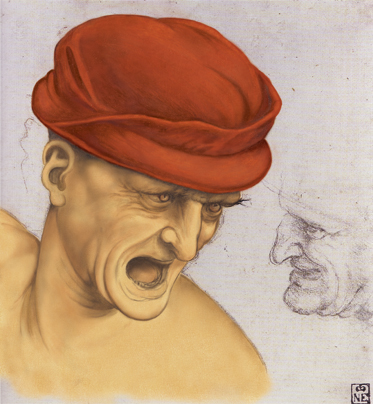
The image above is one example of this, and is a reconstruction based on Niccolo Piccinino's drawings of Leonardo.
When restoring it, we referred to a copy by Rubens and a panel painting of the Doria family, and the depiction of the red hat has a unique and mysterious shape. Since this part is very similar in reproductions other than these two works, it is highly likely that Leonardo's depiction of the Battle of Anghiari was also depicted in this way.
However, there are portraits of Niccolo Piccinino and sculptures that seem to be modeled on real people, but you can see that the shape of the red hat is quite different. Also, Niccolo Picinino's appearance is quite different, making it hard to believe that they are the same person.
I feel that Leonardo clearly ignored the information in the sculptures and portraits.
In this way, the restoration of the Battle of Anghiari requires a very difficult decision even in the restoration of even a single hat.
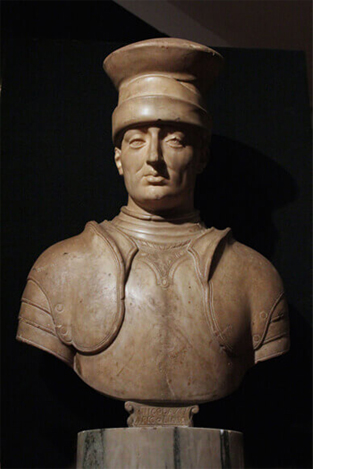
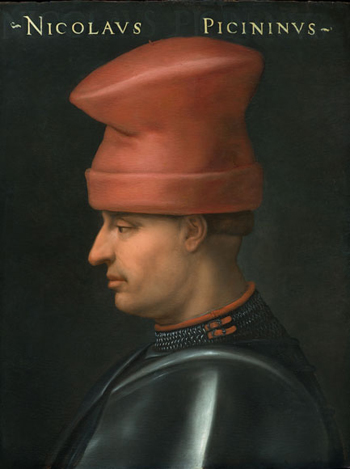
Sculptures and portraits of Niccolo Piccinino.
Niccolo Piccinino seems to have been quite a celebrity even back then, and there are many portraits and coins with his profile engraved on them.
They have generally similar characteristics and are considered to be highly reliable as portraits.
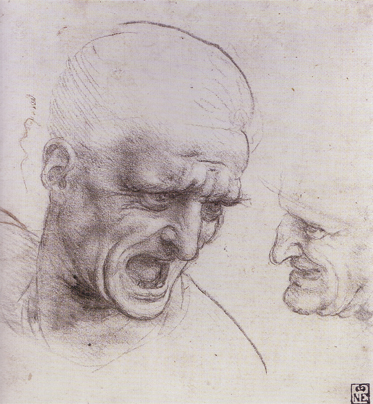
 Leonardo's drawing
The image on the left is a drawing for the Battle of Anghiari.
The most wonderful thing about Leonardo is that he can freely depict human expressions like this.
I feel that Leonardo does not actually make the models create poses or expressions, but rather he freely creates the expressions he wants.
During the Battle of Anghiari, the screen was probably filled with such emotions of anger, fear, madness, and brutality.
Anghiari - Reconstruction

2024/3/15 Reconstruction of the Battle of Anghiari Kiyoshi Bando
Drawing for the Battle of Anghiari
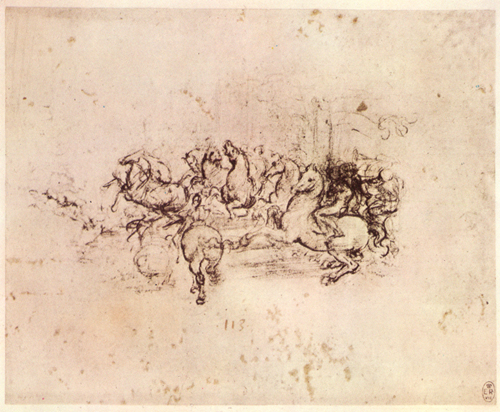 The image on the left is a drawing by Leonardo for Anghiari, and the one on the right depicts the battle scene.
Although it is a fairly small drawing, it is possible that this is the final concept, as Leonardo was able to create the Last Supper from simple sketches like this.
An arch-shaped bridge is depicted on the left edge of this drawing, and a group of horses is depicted charging towards the bridge.
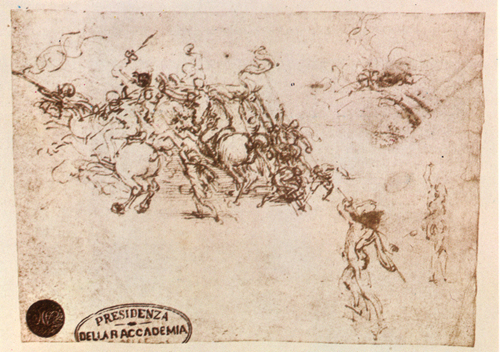 This drawing depicts the central battle scene of the Battle of Anghiari.
Like the image above, it is a fairly final concept drawing, and it is possible that Leonardo drew a larger sketch based on this sketch.
It also includes battle scenes between people and horses in the same postures as Rubens's reproductions, and although it is small and simple, it is a sketch that provides a lot of information.
Also, on the right side of the screen, an arch-shaped bridge is clearly drawn in the distance, and the shape and positional relationship of the bridge can be identified.
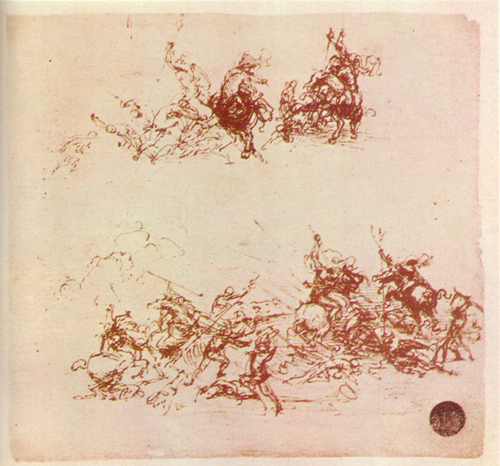 This drawing is also thought to be a drawing for the Battle of Anghiari, but it is less complete than the image above and appears to be still in the conceptual stage.
However, the lower depiction also appears to show the central battle scene on the right.
A river is drawn around the left side of the central battle scene, and to the left of that is another battle scene.
Although the depiction itself is rough, it is a valuable sketch that can provide clues to the overall picture of the Battle of Anghiari.
 This drawing also shows brushstrokes that seem to have been painted around the same time as the above drawing.
The scene looks like a central battle scene, but the detailed shape has not yet been finalized and it feels like an extremely early concept drawing.
Furthermore, the lower part of the drawing depicts a battle scene between infantrymen, indicating that Leonardo intended to place such battle scenes between infantrymen around battle scenes centered on horses.
Restoring the big picture
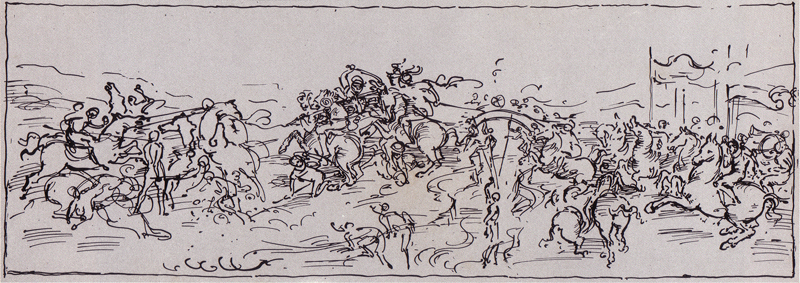
The image below is a reproduction of the overall concept drawing by Carlo Pedretti, who was said to be a leading expert on Leonardo research.
Although it is a simplified depiction, I feel that it has quite accurately reproduced the overall picture of the Battle of Anghiari that Leonardo was trying to portray.
In particular, the relationship between the central battle scene and the battle scene on the right side is exquisite, and it is so complete that there is no need for any further modification. However, the battle scene on the left is an incomplete depiction due to lack of materials.
In order to reconstruct the Battle of Anghiari, an important point is how to depict this left-hand battle scene.
Comparison of central battle scenes
There are two famous copies of the central battle scene from the Battle of Anghiari. One is a drawing by Rubens, and the other is an oil painting called a panel painting of the Doric family.
These two copies each have their own characteristics, and they are important materials indispensable for reconstructing the Battle of Anghiari. In particular, the panel paintings of the Doric family are extremely interesting because not only are the details depicted quite accurately, but even the colors are specified.
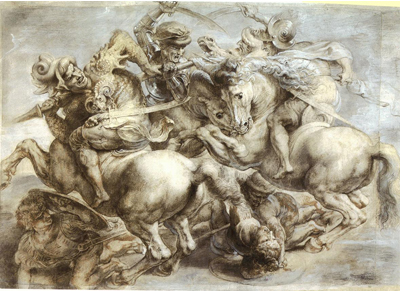
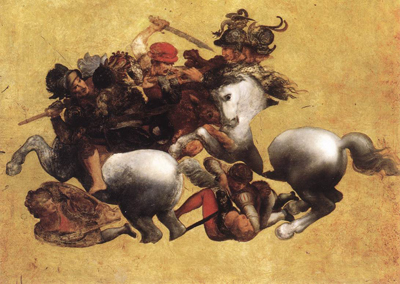
In terms of overall balance, the Doria family's board paintings are more complete and elegantly put together. In addition to these works, there are many other reproductions of this central battle scene, but among them, this panel painting of the Doric family is by far the most sophisticated depiction.
On the other hand, I cannot help but feel that the overall balance of the Rubens copy is awkward, and the accuracy of the details is somewhat inferior. However, the amount of detail is excellent and there is ample amount of information.

The image above is a comparison of two copies superimposed.
Overall, there are many similarities in the depiction of horses, and there is no doubt that Leonardo's depiction of the central battle scene at Anghiari was similar.
On the other hand, when it comes to depictions of people, it can be seen that the overlapping images are quite misaligned. The figures drawn by Rubens are slightly larger. Considering the overall proportions, the depiction of the warrior on the Doric panel appears to be more accurate.
Leonardo likes depictions that are intricately intertwined, and often uses violently twisting poses when it comes to the movements of his characters. In addition, because these depictions are often drawn using difficult foreshortening methods, it often happens that other painters cannot accurately copy Leonardo's works when copying them.
Furthermore, the reality is that there are very few painters who can keep up with Leonardo's delicate depictions of human expressions, which are accompanied by the dignity that is unique to him. This phenomenon is often seen in copies of The Last Supper, proving how difficult it is to copy Leonardo's work.
These characteristics are clearly evident in the Battle of Anghiari, and the countless reproductions are conspicuous in that they are unable to keep up with Leonardo's difficult depictions.
When reconstructing the Battle of Anghiari, it is important to be able to reproduce the facial expressions of these warriors.

leonardoresearch.jp