Restoration of Thomas
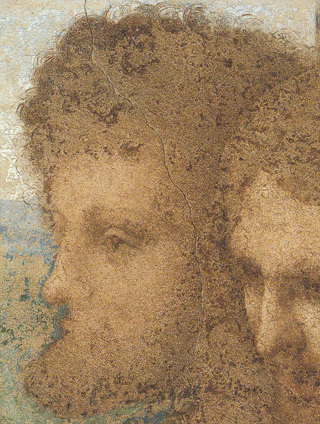
Thomas original - Mural
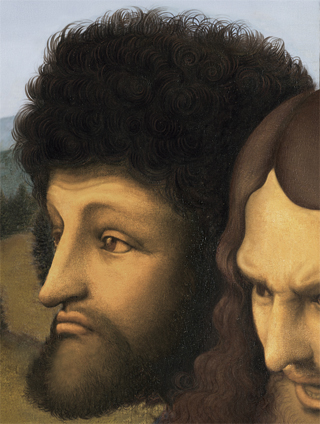
Thomas - reconstruction
The hair on Thomas's head is well depicted in the mural. It is distinctive in that it is painted with quite strong brushstrokes against a blue sky background. This section can be used as a reference when considering how to draw the hair of the apostles at the Last Supper. Leonardo's brush strokes here are drawn all at once without hesitation, and you can feel Leonardo's absolute confidence in this depiction of curly hair.
Thomas' expression is the most difficult to portray in The Last Supper. In most of the reproductions, the facial expression of Thomas is depicted as that of an ugly monkey, and there are no expressions depicting him with the grace and dignity that Leonardo would have depicted. Therefore, recreating Thomas' facial expressions is a very time-consuming task.。
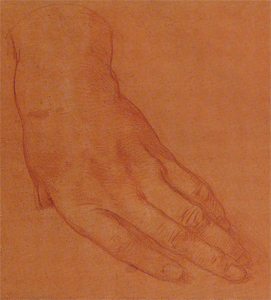 Thomas hand drawing
A hand drawing for Thomas survives in the Windsor Castle Collection.
The drawings, drawn in red chalk, look like they were drawn from real people, such as the realistic wrinkles in the knuckles. However, I feel that Leonardo did not like to include such vivid expressions in his paintings, and in many cases he focused on elegance and beauty.
Restoration process
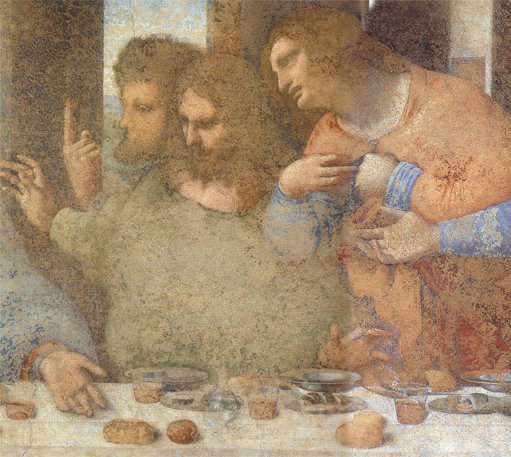 The facial expression of Thomas in the mural has been barely restored, with only slight shading.
Pinin Brambilla's high sense of painting can be seen in the dexterity in this area.
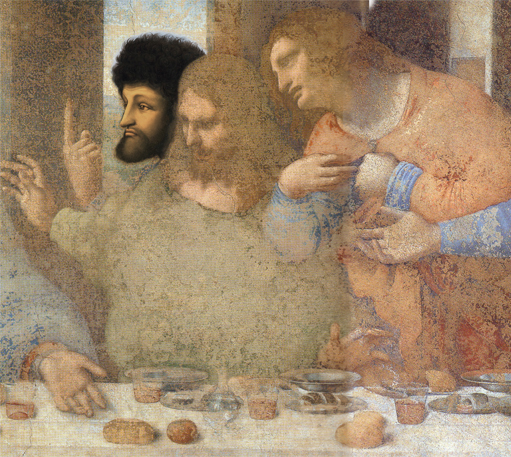 Reconstruction of Thomas's head.
Since Thomas is depicted right next to Jesus in the center, it is a challenge to figure out how to depict his expression.
Even a slight change in facial expression can greatly affect the overall impression, requiring a great deal of trial and error.
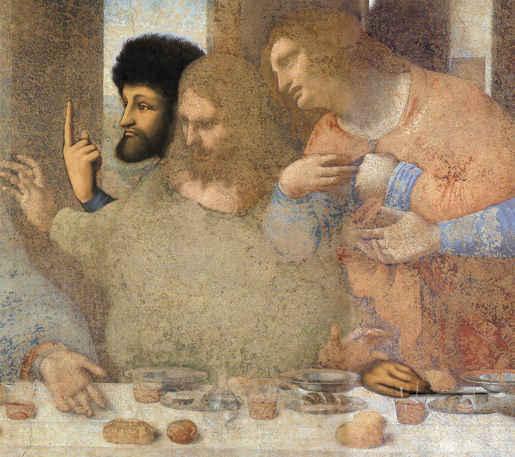 Restoration of Thomas' hand.
To reconstruct Thomas's right hand, we used Leonardo's drawings of the fingers of John the Baptist and the fingers of the angel of Our Lady of the Rocks as references.
This pose of pointing to the heavens may have been a favorite of Leonardo's, as he continued to use it from his earliest paintings, The Adoration of the Three Wise Kings, to his final work, John the Baptist.
The left hand has been restored based on a drawing from the Windsor Castle collection.
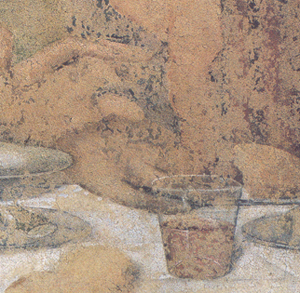
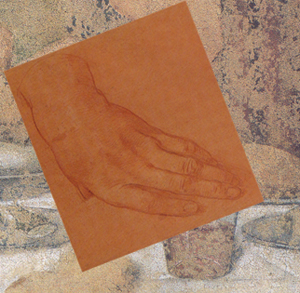
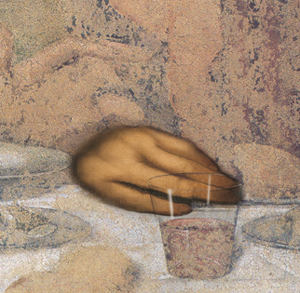
How to draw fingers
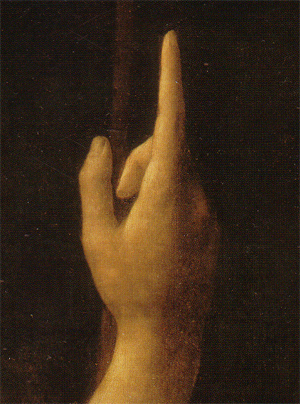
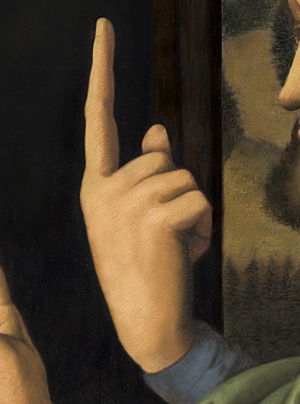
John the Baptist's finger
Reconstruction: Thomas' finger
The way Leonardo drew his fingers changed little by little depending on the age.
Especially in the early stages, there is a tendency to draw the knuckles tightly. Her fingers are also thin and long, and curved in a curved manner, giving her a delicate and delicate look. However, as the age progresses, the fingers become rounder and the way they bend becomes gentler, resulting in an overall softer expression.
The fingers of John the Baptist on the left are depicted in his later years and appear to have softened considerably. However, the expression of Leonardo's fingers from the time when The Last Supper was painted still has early characteristics. Therefore, the way Thomas's fingers are drawn is based on the angel's fingers depicted in Our Lady of the Rocks.
Comparison of reproductions
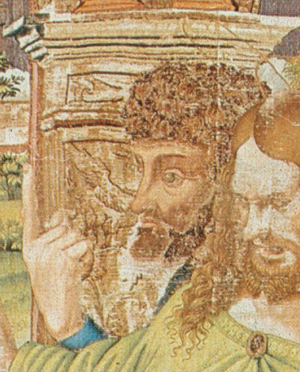
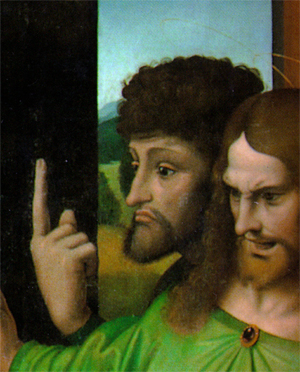
Vatican tapestory - Thomas
Giampietorino - Thomas
There are parts of Thomas's face that are drawn to give him Indian features. Examples include thick lips and dark skin. The reason why it is depicted that way is because it is based on the tradition that Thomas eventually spread his word to India, but it feels a little strange since Thomas himself was not Indian.
Restoration of Thomas's foot
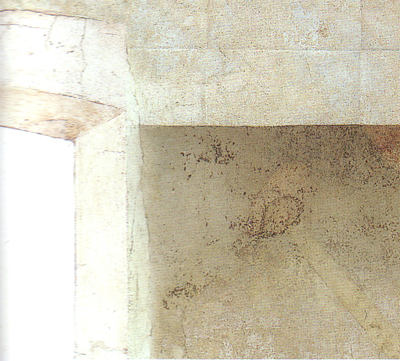
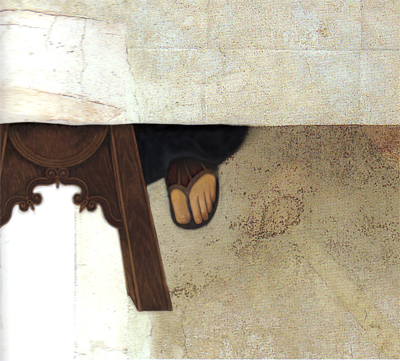
Mural Thomas's Feet
Reconstruction of Thomas' feet
Thomas' feet in the mural are completely missing. In today's Last Supper, the parts below the table are all in a bad state of preservation, but Thomas's feet are not a good or bad thing; they have completely disappeared, so it's a part that can't be helped. .
Rather than a restoration, it is a completely new creation.
http://leonardoresearch.jp/ August 24 2014

leonardoresearch.jp