The Annunciation: Traces of Leonardo
Leonardo was working in the Verrocchio workshop at this time, and was not an independent painter.
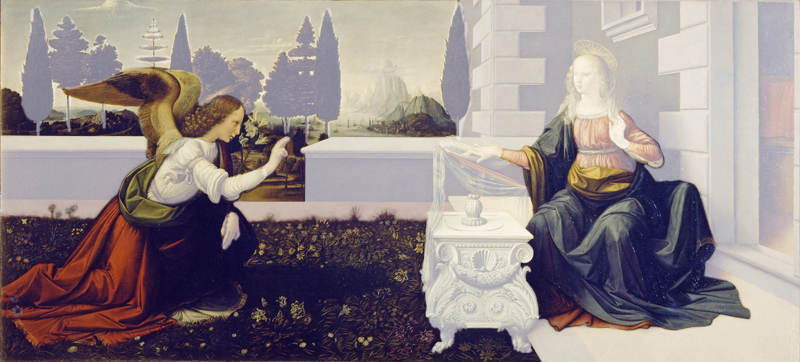
This Annunciation is often said to have been painted by Leonardo, but in fact he assisted in the production, and was not in charge of its creation. This painting should more correctly be called a work by Verrocchio's workshop or Lorenzo di Credi (Assumption).
The image above shows which parts Leonardo painted.
Leonardo was mainly responsible for the background and flowers in the foreground, as well as the coloring of the clothing of the Virgin Mary and the angels.
As such, being in charge of the background put him at the bottom of the hierarchy among the painters involved in the production of this painting.
Naturally, Leonardo was not in a position to decide how this painting would be produced.
In this painting, Leonardo is merely a production assistant.
|
The AnnunciationOil and tempera on poplar, 100 x 2215 cm Florence, Galleria degli Uffizi, Inv. 1618
The painting is wide enough that the figures are drawn very carefully, and the careful finish of the details proves the high level of the work of the workshop that represents the Renaissance period. In this painting, Leonardo is in charge of the background as usual. However, the cypress-like trees in the background were painted by another painter, and are systematically the same as the trees that are often depicted in the background of Ghirlandaio's works. It is safe to say that Ghirlandaio was probably involved to some extent. The background of the Annunciation, which Leonardo was in charge of, is somewhat more polished than the background of the Baptism of Christ, and there is a sense of slight improvement. In particular, the distant mountains painted with aerial perspective have a stronger presence than before, and are given a larger role in the background depiction. Considering the way the background is painted, it is highly likely that this painting was painted after the Baptism of Christ. After completing the background, Leonardo next worked on the flowers in the foreground. The way he painted this part is unique to Leonardo, especially in the way he painted the leaves. When painting leaves, Leonardo painted the leaf outlines with sharp brushstrokes, and tried to give the leaves a three-dimensional look by painting shadows inside the leaves. This style is also evident in the Virgin of the Rocks, painted about 10 years later, proving that when Leonardo painted plants, he painted them based on his own concept, rather than sketching them from the real thing. However, Leonardo's way of painting plants in the Annunciation is still a trial and error process. Next, regarding the depiction of the clothing, the Virgin Mary's yellow clothing and the angel's green clothing are very similar to those of the Virgin of the Rocks, so it is safe to say that it was painted by Leonardo. It is likely that Leonardo had already fully established a way of depicting these types of clothing when he painted the Annunciation. However, I honestly think it is difficult to judge who painted what parts of the other clothing. If I had to make a judgment, I would say that it is reasonable to assume that the angel's red clothing and the Virgin Mary's blue clothing were painted by Leonardo, since they were not painted with pure tempera, but with a mixed technique of tempera and oil paint, or with oil paint. As for the rest of the clothing of the Virgin Mary and the upper body of the angel, it may be reasonable to say that it is highly likely that they were painted by a painter other than Leonardo, since most of it is painted with tempera. Next, regarding the head of the Virgin Mary, I believe that this part was painted by Lorenzo di Credi. The reason is that the expression on the Virgin Mary's face is very similar to the expression of women painted by Lorenzo di Credi. In particular, there is a considerable similarity to the expression of the Virgin Mary in "The Annunciation," another work by Lorenzo di Credi in the Uffizi Gallery. As for other works, the facial expression of the woman in "Venus" by Lorenzo di Credi, owned by the Uffizi Gallery, is also quite similar. As such, it is highly likely that Lorenzo di Credi painted the head of the Virgin Mary. However, the angel's head is slightly different. I am concerned that the face and hair of this angel's head are different from the Virgin Mary's head. The Virgin Mary's head is painted with a tempera-like brushstroke, but this angel's head is painted with an oil painting-like brushstroke. The highlights on the hair are more delicate than those of the Virgin Mary. And above all, there is a great sense in the way the curly hair is painted. Based on these characteristics, I believe that the angel's head was painted by Leonardo. And the last question is about the angel's wings, and I believe that these angel's wings were also painted by Leonardo. The reason is that in another Annunciation painted by Lorenzo di Credi, the angel's wings are painted with traditional, highly decorative colors. This careful approach to production that values and respects tradition is one of Lorenzo di Credi's characteristics, and the innovative approach of depicting the realistic wings seen in this Annunciation certainly gives a sense of Leonardo's individuality. And one more thing to add is Leonardo's strong interest in birds. Leonardo also goes into detail about bird flight in his own notes. We don't know when he first became interested in birds, but I think it's quite possible that he began his research out of a need as a painter to paint angel wings like these. I believe that this strong interest in bird wings may have influenced the depiction of the angel's wings in this Annunciation.
|

leonardoresearch.jp