Restoration of Judas
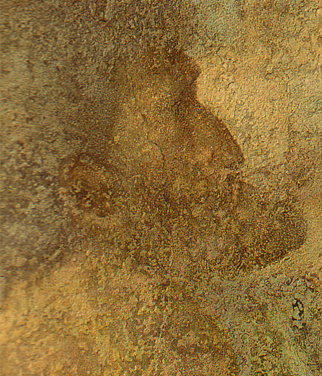
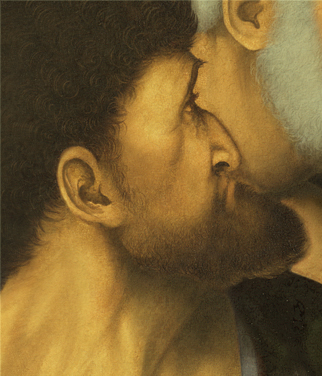
Judas head original
Reconstruction of Judas head
Features different from murals
The image below is a drawing of the head of Judas by Leonardo, which is held in the Windsor Castle Collection.
The drawings are made using red chalk on coated paper. Leonardo also left behind many drawings drawn in black chalk from around the same time, so it seems that Leonardo did not strictly distinguish which color to use for these figure drawings.
In this drawing, Judas appears to have somewhat elderly features, but in the actual mural, it can be confirmed from many reproductions that he was depicted with a slightly younger appearance. Leonardo may have made similar changes when actually painting his murals.
Furthermore, the depiction of the neck, where the muscles are clearly prominent, is not particularly emphasized in many reproductions, giving the impression that the expression is rather modest.
This is probably because it was judged that drawings that only show muscles and sinews were too old-fashioned.
Judas's head is slightly angled slightly backwards, so there is limited space to draw his facial expressions, but Judas's delicate facial expressions are expressed in that small amount of space. This can be said to be an outstanding skill unique to Leonardo.
I am paying attention to the direction of Judas' gaze. The fact that Judas' gaze is directed slightly backward means that Judas is depicted in front of Jesus Christ. In other words, there is evidence that at the time this drawing of Judas was drawn, Leonardo was thinking of placing Judas in front of the table.
In the drawing Leonardo prepared for the Last Supper, Judas is depicted in the traditional composition, sitting alone at the front of the table.
Leonardo abandoned this composition midway through, but it is possible that he was still adhering to the traditional composition at the time this sketch of Judas was drawn.
 Characteristics of drawings
1. Appearance reminiscent of an old man
2, beardless chin
3, short hair
4. Looking slightly backwards
Repair process
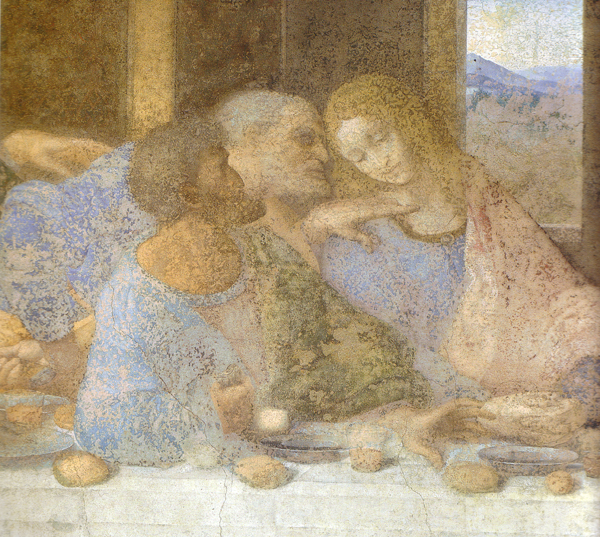 Original condition
The most distinctive feature of the original painting of Judas is the color of his skin.
Who among the 12 is Judas? To make this clear at a glance, Judas' skin is submerged in dark shadows.
Although it is impossible to decipher the important expressions of the face, there are quite a few outlines left, which can be used as a guide for restoration.
The condition of the original painting: The condition of the outline is not so bad.
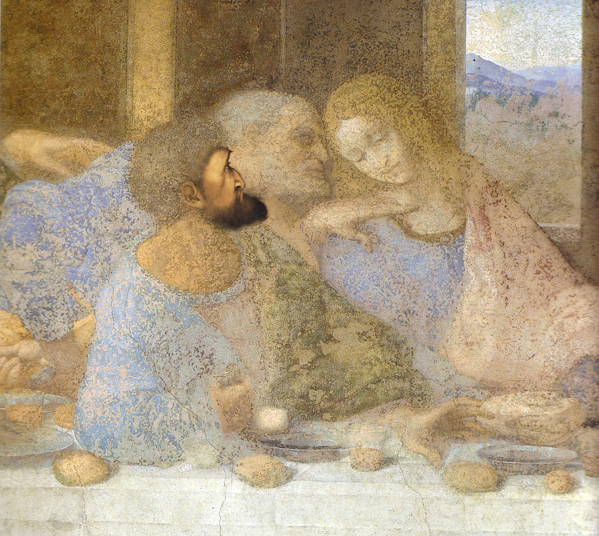 Facial restoration
Judas' face can be restored based on Leonardo's drawing, but some modifications will be necessary.
Particular attention should be paid to the direction of the line of sight; if the drawing were to remain unchanged, Judas's line of sight would pass over Jesus Christ's head. Therefore, for Judas' eyes, it is necessary to lower the eyelids a little and lower the gaze.
In addition, the wrinkles on her forehead have been kept to a more understated look to make her look a little younger than the sketch.
Regarding the color of Judas's face, I did not make it darker than necessary. This is because I feel that too dark colors disrupt the overall harmony of the screen.
However, many restored drawings have been reproduced in extremely dark colors, so it is possible that Leonardo's original drawings were actually quite dark in color.
Reconstruction of the face and beard: The line of sight is drawn a little lower than in the sketch.
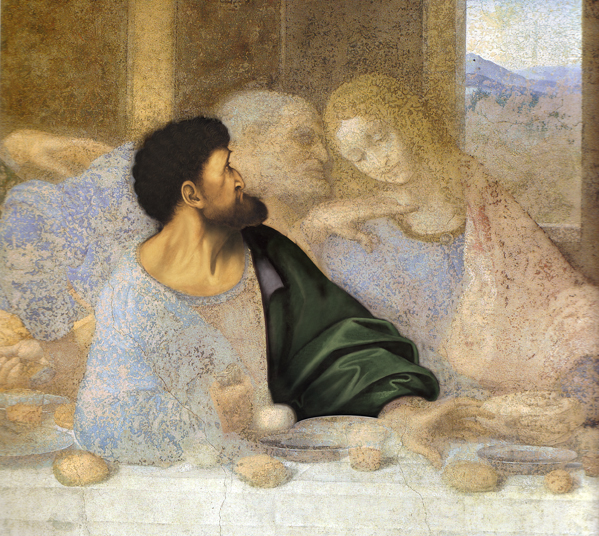 Restoring the cloak
In the original drawing, the outline of the cloak is quite intact, but the detailed depiction of the inside is not very good.
Therefore, the detailed shape of the cloak has been restored based on Giampietrino's reproduction.
Regarding the depiction of the details, we have restored them based on the way the cloak is depicted in Our Lady of the Rocks. Also, regarding the green color of the cloak, I tried to reproduce it in a slightly deeper green based on the color tone left in the original painting.
The color of the cloak was restored based on the color remaining on the wall.
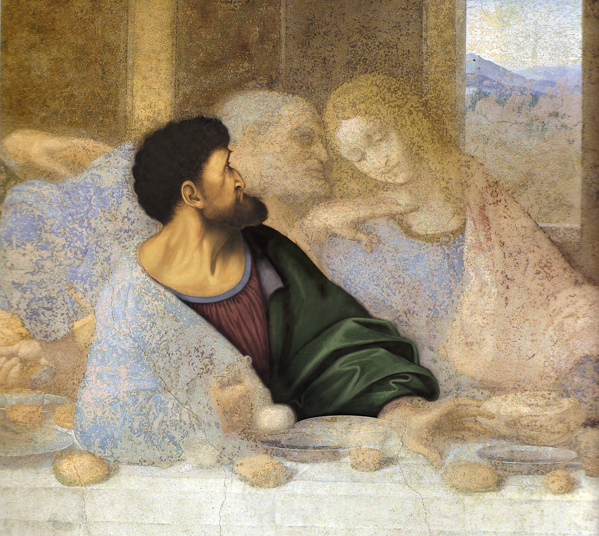 Restoration of chest costume
In my reconstruction, the garment on Judas's chest is reproduced in purple based on the color remaining on the wall, but in the Vatican tapestry and Giampietrino's reproduction, this part is painted in yellow.
The color yellow represents a traitor, and I think it is quite possible that Leonardo's original painting was also yellow.
The clothing on the chest has been reconstructed in purple, but the possibility that it was yellow cannot be ruled out.
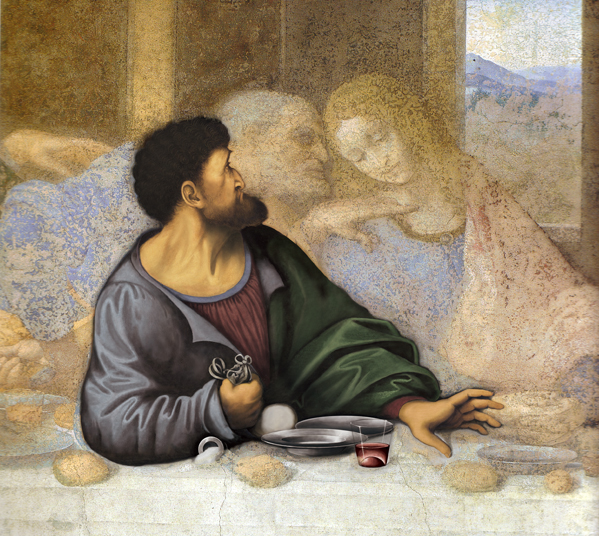 Restoration of blue clothes
I am very worried about what color to use to reproduce Judas' blue clothes.
In the original painting, this part is painted in a similar blue color to John, Judas, and Peter. Therefore, it is difficult to determine how to distinguish the colors of the three people's clothes.
Additionally, the Vatican Tapestry and Giampietrino's reproduction are each painted in completely different colors.
I'm not sure which one to trust.
In the end, I recreated it with Giampietrino's dark purple light blue.
In front of Judas' right wrist was a picture of a fallen salt pot.
Comparison of reproductions
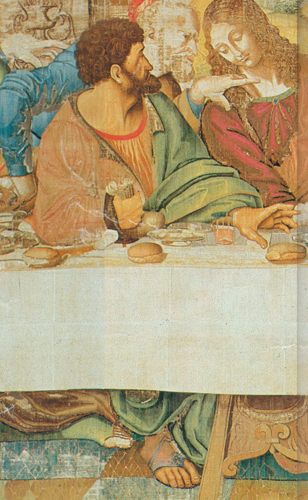
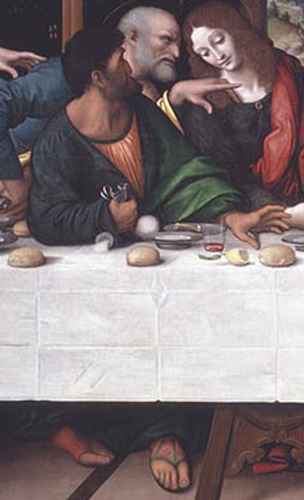
Vatican tapestry
Giampietrino reproduction
Some parts of the two reproductions are painted in completely different colors, making it difficult to decide which one to trust.
There is a particularly large difference in the area from Judas's right shoulder to his wrist, and it seems that the cause is not simply fading of the pigment.
On the other hand, it is also interesting to note that in the depiction under the table, the angle of Judas' right foot is different in the two reproductions.
Restoration under the table
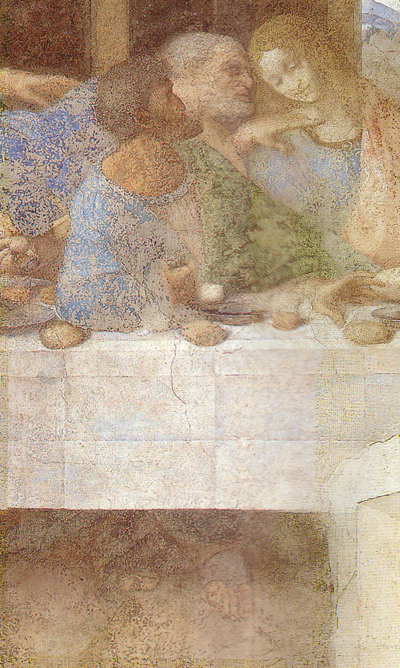
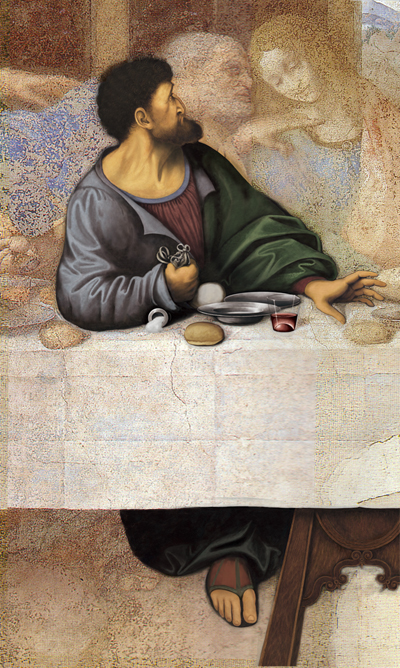
Below this table, the original drawing is in a very poor state of preservation, with a large area occupied by a complete loss of the original drawing layer.
At first glance, it appears that the outline of Judas's right foot remains, but in reality, most of it is an addition based on predictions, and its reliability is not very high.
http://leonardoresearch.com/ August 12 2014

leonardoresearch.jp