Restoration of Philip

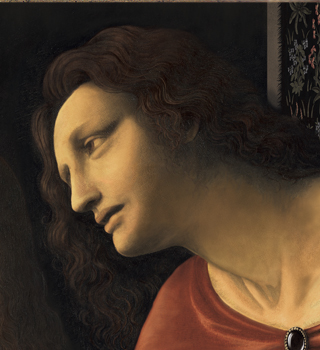
Philip's head in the mural is not in good condition, but it has barely recovered enough to show a glimpse of Philip's original expression.
This expression on Philip's face is depicted using difficult foreshortening. Therefore, when later painters repaired it, they were unable to keep up with the difficult shortening method, resulting in a rather distorted expression. However, after its restoration by Pinin Brambilla, it was returned to a depiction much closer to Leonardo's original, and it plays a part in the composition of important scenes in The Last Supper.
Drawing of Philip's head
 A wonderful drawing for Philip remains in the Windsor Castle collection.
At first glance, it looks like it could be used as is for the Last Supper, but it actually requires a lot of modification.
The frame area in particular needs modification and will not fit into the mural unless it is considerably shortened. This is where the shortening method becomes difficult.
Drawing the heads of these people using difficult foreshortening techniques was a popular drawing method during this time, and was a technique that was the hallmark of a top-notch artist. Therefore, many painters incorporate it into their paintings, and Leonardo is no exception.
The work that Leonardo was most influenced by in terms of depiction from this angle is probably "The Annunciation" by Lorenzo di Credi, who worked in the same workshop. In addition to the expression on the angel's face, the prototype of Philip can also be seen in the expression of the rich curly hair.
The image below is a comparison of Philip's drawings superimposed on the mural and reconstruction.
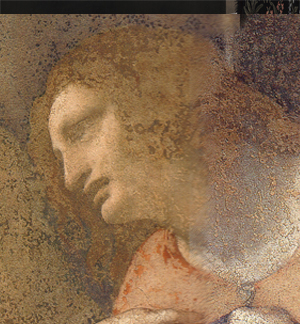
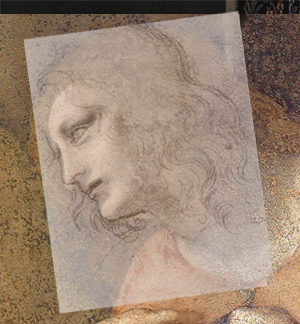
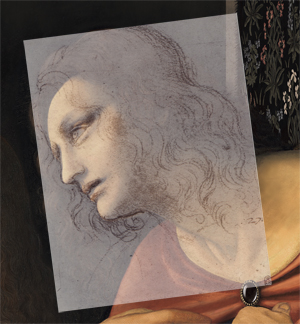
Comparison of murals, drawings, and reconstructions
Restoration process
 The mural of Philip also has some pretty tough parts overall. Most parts are missing, leaving the walls exposed.
Almost all that remains is the outline, but even with this outline there are some parts that are unreliable.
One is that Philip's jawline falls too far down around his neck, making his neck appear incredibly thick. In reality, you need to correct it a little higher to make the neck line neater.
The other thing is the outer line of the body, including the head, and I feel that the whole body bulges out too much to the right. I especially feel that my hair, neck, and beginning of my shoulders are shifted to the right.
 Philip's head restoration
This expression of Philip's expression is an important part of the Last Supper, so it will be difficult to restore.
There are very few reproductions from Leonardo's time that accurately depict this part. The only reference I have is Giampietrino's reproduction of Philippo.
 Restoration of the red cloak
Most parts of the mural are missing. Therefore, we have no idea how Philip's cloak was depicted.
Therefore, the restored drawings are based on Giampietrino's reproductions.
 Restoration of hands and blue clothing.
In the few works left by Leonardo, the blue of the clothes of the people depicted is usually a dark, slightly blackish color with low saturation.
Not a single piece of work remains that is painted in the bright blue color of his contemporaries.
Comparison of reproductions
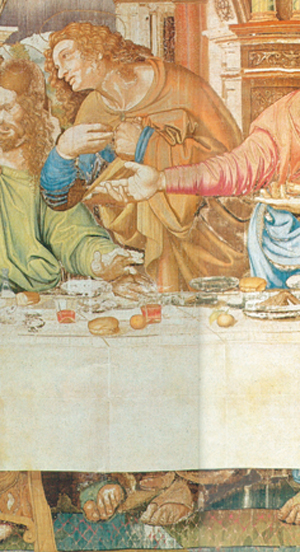
Vatican tapestry
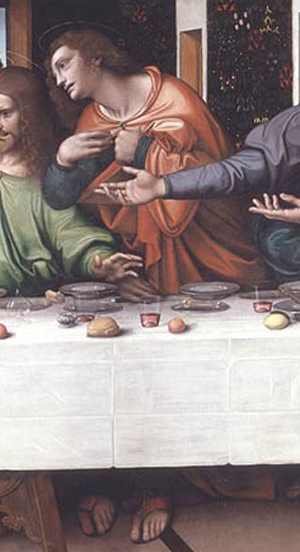
Giampietrino reproduction
The depiction of clothing is generally the same. The restoration drawing is based on the characteristics of these two reproductions and the traces left on the mural.
These two reproductions also serve as important reference materials not only for the people, but also for the arrangement of plates on the table, the amount of wine in the glass, and the position of the bread and oranges.
Restoration of Philip's feet
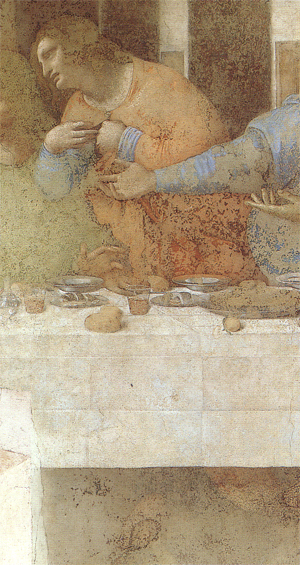
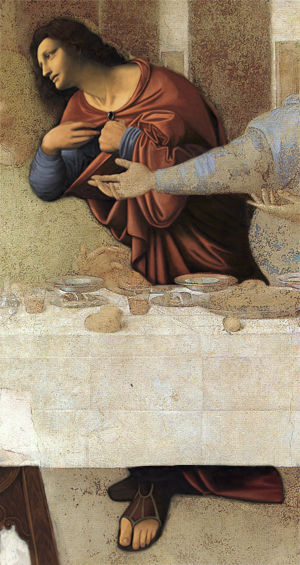
In the current Last Supper screen, the area below this table is in an extremely poor state of preservation, with almost no drawing layer remaining.
It is likely that conservation restoration was abandoned quite early on. The most egregious example of this is at the feet of Jesus. Instead of restoring it, they cut holes in the walls and installed passages, which they did not feel was necessary as a painting at all. It seems that the result of this kind of treatment continued for centuries is reflected in the state of preservation at the bottom of the screen.
Restoration of dishes and dishes on the table
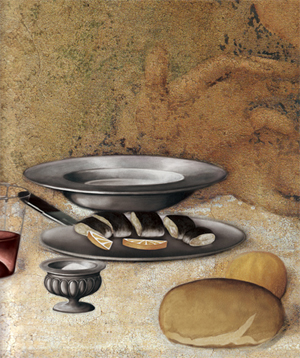
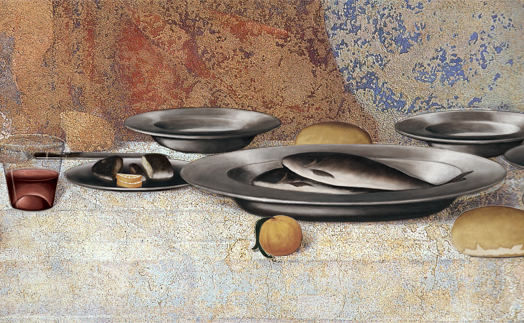
As for what was depicted at the Last Supper, not only the people but also the still life on the table are important factors.
However, although there are many reproductions of The Last Supper, there is no accurate representation of the still life on the table. In most cases, it has been omitted or redrawn. In particular, the dishes on the plates vary, making it difficult to identify what was actually depicted.
It is thought that it was probably a fish, but there is no conclusive evidence. There is also a theory that it is an eel, but I feel this is even less reliable than a fish.
In the end, the restoration drawings are based on a reproduction of the Last Supper, said to be by Cesare Magni, which is owned by the Brera Museum. In this reproduction, two fish are depicted on the platter on the right, and many fish are depicted on the platter on the left. The importance of these two fish is that the depiction is probably based on an anecdote about two fish that is famous in Christianity.
Even in Leonardo's painting of The Last Supper, you can see the traces of many fish on the platter on the left. Unfortunately, the drawing layer on the platter on the right is completely missing, so it is impossible to judge, but it is quite possible that it was actually two fish.
http://leonardoresearch.jp/ September 7 2014

leonardoresearch.jp