Restoration of John
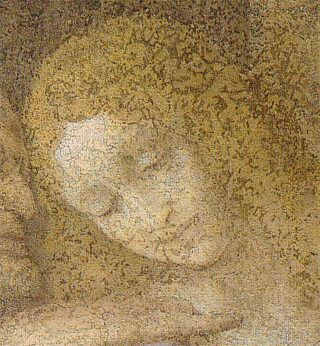

John - original
John - reconstruction
The state of preservation of the mural of John is quite serious.
On the face, only a faint layer of Leonardo's drawing remains on the hairline of the forehead, and only small fragments are scattered on the rest of the face. Leonardo's drawing layers do not exist in important areas that determine John's facial expressions, such as the eyes, nose, mouth, and contours from cheeks to chin.
The part of John's face that is currently visible is a reconstruction based on the conservator's predictions, and is not based on any concrete basis. Therefore, it must be said that its credibility is extremely low.
For example, the contours of John's face are also recreated by the restorer, but I feel that the reconstructed face of John is a little too small. You wouldn't notice it if it was just John, but if you compare the size of his face with that of the other apostles, you will notice that his face is quite unnatural in size.
What is even more striking is the outline of Peter's face next to him, which is completely different from the outline of Peter depicted in many reproductions.
It can be said that this is the part where the contour reproduction clearly fails.
There are many areas on the left side of the mural where the authenticity of these contour reproductions is questionable. I imagine that the reason for this is that the involvement of Mr. Pinin Brambilla, who was in charge of the restoration, has decreased significantly since the restoration of John.
The reason why she was not heavily involved in the restoration work of The Last Supper is probably due to the intention of Milan's Directorate for the Preservation of Art and Historic Properties, which was in a hurry to complete the restoration.
Restoration of the Last Supper began in 1977 by Pinin Brambilla, and the restoration of Jesus Christ was finally completed in 1993. It took about 16 years to repair half the screen, so if you do some simple calculations, the restoration will be completed around 2010.
The Directorate for the Preservation of Art and Historic Properties of Milan couldn't wait until 2010, when this restoration would be completed. In the end, the restoration of the Last Supper was completed in 1999. It is highly likely that they intended to wait only until 2000.
Another reason is that by the time John was being restored, she was already nearly 70 years old. It is easy to imagine that working alone in front of the wall in the winter, repairing the work in the vast space of what was once the dining room, must have been at the limit of her physical strength. Given his age, it was natural for him to give up on completing the Last Supper and focus on nurturing his successors.
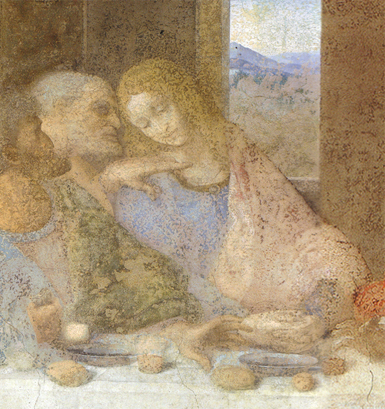
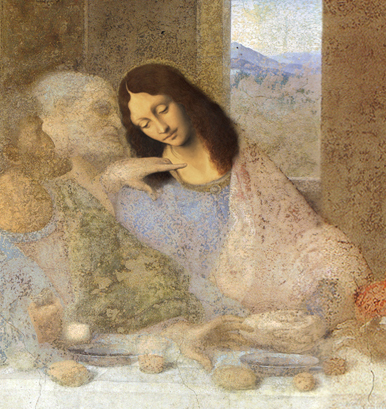
The color of John's face in the mural seems quite white compared to the others.
Reconstruction of John's head
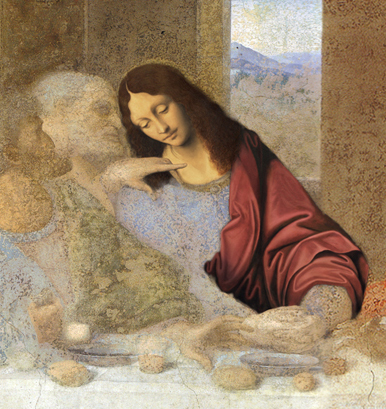
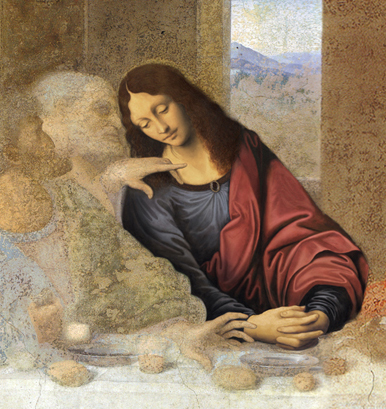
Restoration of the red cloak
Restoration of hands and clothing

Reproducing the purple color of clothing
Comparison of reproductions
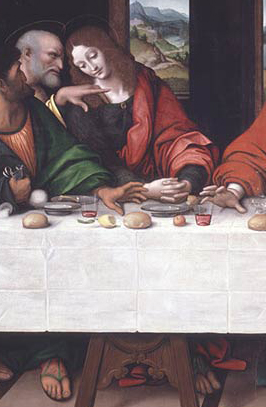
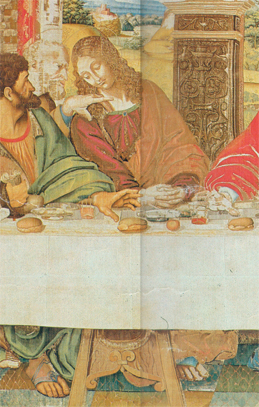 It has been confirmed that John's clothing was glazed with red pigment over a blue base coat, giving it a purple finish.
In Giampietrino's reproduction, this purple color is quite deep, giving it a dark navy-blue color.
On the other hand, in the Vatican tapestry, the red grace seems to be too strong.
In the case of the Vatican tapestries, since they are embroidered with thread, the pigments used are dye-based pigments, and as the colors fade rapidly, it is difficult to determine what the original colors were.
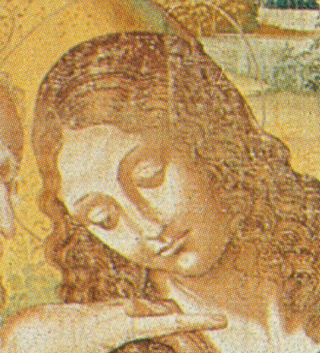 Vatican tapestry, head of John
John's hair was depicted as having thick curls. At first glance, Giampietrino's reproductions seem to be easier to refer to when it comes to depictions of hair, as they are oil paintings, but in reality, they are simply drawn with many omissions. In many cases, it may not be very helpful.
On the other hand, since the Vatican tapestries are embroidered, I feel that they are not suitable for detailed depictions, but in reality, they strive to faithfully reproduce the outlines, so it is difficult to understand the form of what was depicted. This will be an important document when verifying whether something like this happened.
Restoration of John's feet
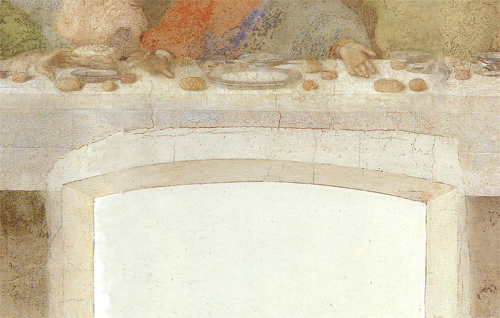 In 1652, a hole was cut in a section of the wall to provide a passage directly beneath Jesus Christ.
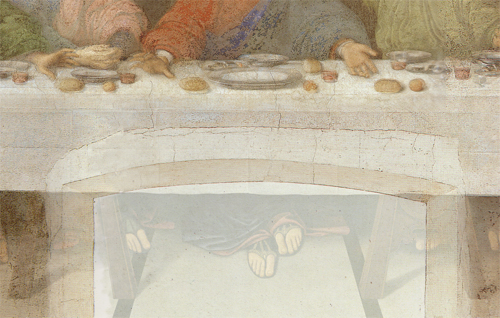 Because of this passage, the feet of Jesus Christ, the feet of John, and one leg of the table are completely lost.
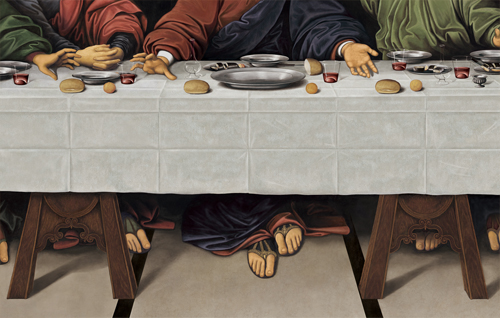 Restoration under the table
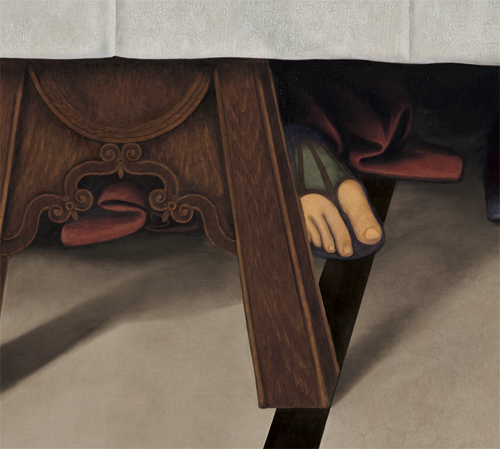 Restoration of John’s legs, enlarged portion
Restoration of the Hand of John
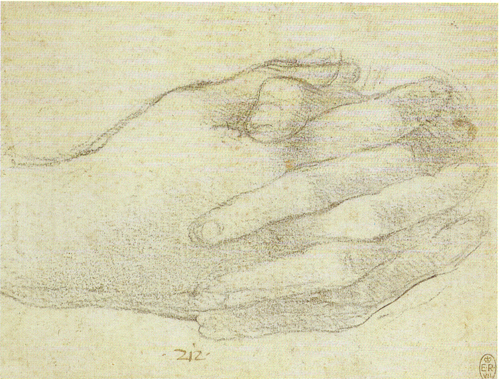 Leonardo's drawing of John's hand remains in the Windsor Castle collection.
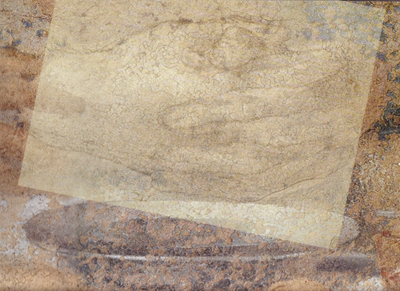
When you superimpose this drawing on the mural, you can see that the outline is quite misaligned. Also, the same goes for reproductions, etc., and Leonardo did not always accurately project this drawing on screen.
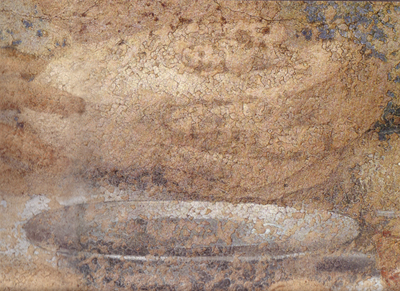
John's hand - mural
An image of a drawing superimposed on a mural
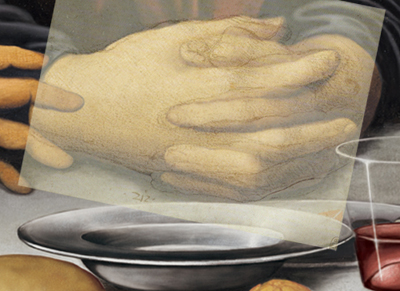
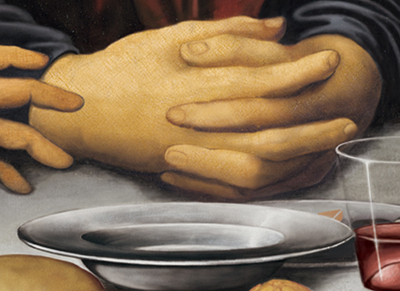
A diagram with a drawing superimposed on the restored map
Reconstruction image
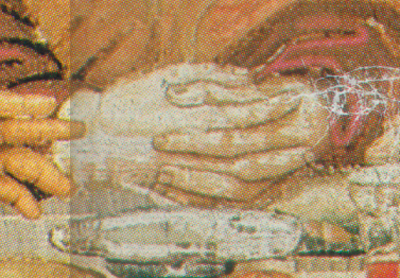
Hand of John from the Vatican Tapestry
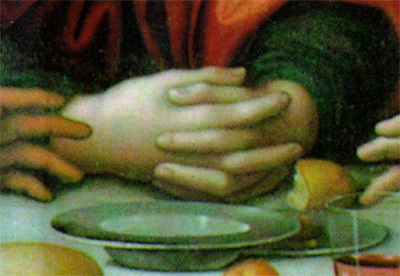
Giampietrino's reproduction of John's hand
http://leonardoresearch.com/ August 10 2014

leonardoresearch.jp